
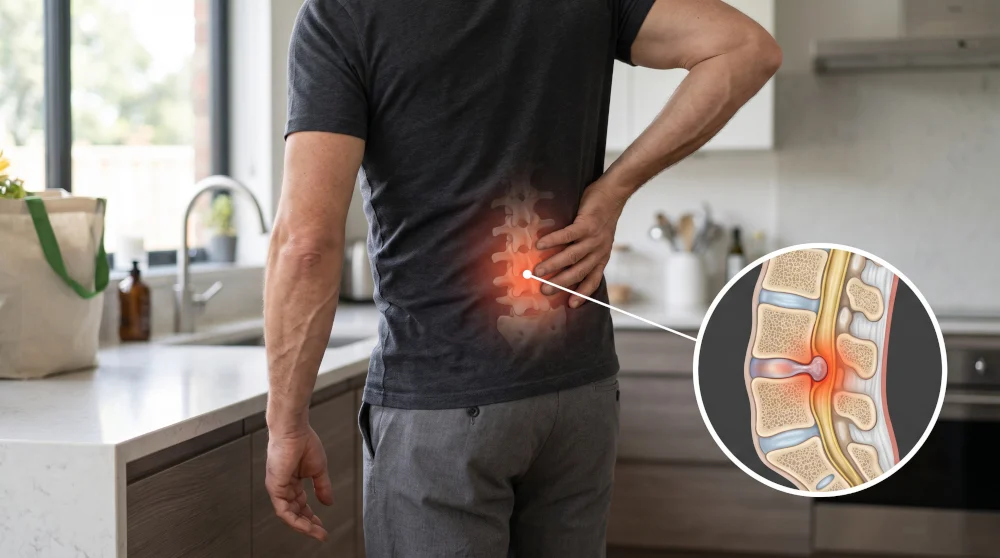
A disc finding on an MRI can sound alarming. Yet “bulging,” “herniated” and “degenerative” do not tell the whole story. Some people have significant-looking changes with few symptoms, while others have pain, tingling or weakness that affects daily life. The useful question is not simply whether a disc is abnormal. It is whether the examination, symptom pattern and available imaging point to a disc-related problem – and whether a table-assisted approach is appropriate for that individual.
At Revive Spine and Wellness in Jupiter, Dr. Kleinfeld evaluates the history, movement, neurological findings and relevant imaging before recommending care. For a person whose examination findings support this approach, the plan may include Cox Flexion Distraction, the controlled table-assisted method Revive uses for spinal decompression. It is not offered as a promise to “put a disc back in,” eliminate surgery or produce the same result for everyone.
What Is the Difference Between a Bulging and Herniated Disc?
Spinal discs sit between the vertebrae and help distribute load. A bulging disc generally describes a broader extension of disc tissue beyond its usual boundary. A herniation is a more focal displacement of disc material. The exact wording can vary by radiologist and by the shape of the finding. Either may be incidental, or may irritate a nearby nerve root and contribute to arm or leg symptoms.
Symptoms that deserve evaluation can include localized neck or low-back pain, pain travelling into an arm or leg, tingling, numbness, altered reflexes or weakness. Location alone does not identify the cause. Similar symptoms can arise from joints, muscles, peripheral nerves, spinal stenosis and medical conditions outside the spine.
How Revive Evaluates a Disc-Related Concern
The first step is an examination, not a predetermined treatment package. Dr. Kleinfeld reviews when the symptoms began, what makes them better or worse, prior injuries or surgery, medications and relevant health conditions. The examination may include movement, orthopedic and neurological checks. Existing X-ray or MRI reports are considered when relevant. If new imaging is clinically indicated, Revive coordinates off-site imaging and radiology interpretation rather than assuming every patient needs a scan.
The evaluation also looks for reasons chiropractic care should be modified, postponed or replaced by medical referral. A condition label alone does not establish that decompression is suitable.
What Does Table-Assisted Spinal Decompression Involve?
Revive uses a Cox 8 Flexion Distraction table for cervical and lumbar care. The table allows Dr. Kleinfeld to position a selected area and apply directed contact while using controlled flexion, distraction or other measured movement. This differs from the quick movement people often associate with a traditional adjustment. The amount and direction of movement are selected from the examination findings and your response.
The intended clinical goals may include improving comfortable movement and changing how a painful spinal area is loaded during care. Cox materials also discuss proposed biomechanical effects involving disc and nerve-root spaces. Those mechanisms should not be translated into a guarantee that a disc will heal, retract or stop causing symptoms. Clinical response must be monitored over time.
When Might the Approach Be Considered?
Following examination, Cox Flexion Distraction may be considered for some people with a disc herniation or bulge, radicular symptoms, sciatica, degenerative disc changes, spinal stenosis-related pain, or associated neck or low-back pain. It may be used alone or alongside other appropriate chiropractic services, such as a Diversified adjustment, soft-tissue care, supportive modalities or home exercises.
The same approach is not right for every disc finding. Pregnancy, bone health, recent trauma, prior surgery, progressive neurological changes and other medical factors can alter the plan. Post-surgical pain in particular requires careful review and, when appropriate, communication with the treating medical team.
What a Session May Feel Like
You are positioned on the table while Dr. Kleinfeld applies controlled contact and table motion to the selected area. A decompression session at Revive is typically about 20 minutes, although the complete visit may vary. You should report any sharp, increasing or unfamiliar symptom immediately so the position or plan can be reassessed.
There is no responsible universal answer to “How many visits will I need?” Revive may initially discuss a care period and planned re-evaluation, but frequency and duration depend on the findings, functional goals and response. Progress should be judged against specific measures – such as leg-pain distribution, sleep, walking tolerance, movement or strength – not merely by completing a package.
When Medical Care Is Urgent
- Seek urgent medical assessment if you develop:
- New loss of bowel or bladder control
- Numbness in the saddle or groin region
- Rapidly worsening weakness
- Severe pain after major trauma
- Fever with severe back pain or other sudden systemic symptoms
These symptoms need medical attention rather than a routine chiropractic appointment. Call emergency services when symptoms are severe or immediately threatening.
A Practical Takeaway
Spinal decompression may form part of care for some people with a herniated or bulging disc, but the decision should follow an individualized examination. The most credible goal is not a dramatic anatomical promise. It is a measured plan, clear review points and referral when the findings call for a different level of care.
If disc-related pain is limiting work, sleep or activity, contact Revive Spine and Wellness in Jupiter to schedule an evaluation and discuss whether Cox Flexion Distraction may be appropriate for you.
Why the MRI Finding and the Symptoms Must Be Compared
Disc findings are common, particularly as people age, and they do not always explain pain. A useful evaluation asks whether the level and side of the finding match the symptom distribution, strength, sensation, reflexes and movement response. When those pieces do not fit, the clinician should consider another source rather than treating the scan.
Conservative Care Is One Part of the Decision
Many disc-related presentations are initially managed without surgery, but ‘non-surgical’ should not be interpreted as a promise that surgery will never be needed. Conservative care may include activity guidance, exercise, medication directed by a medical provider, physical therapy, chiropractic care or watchful monitoring. The appropriate combination depends on severity, neurological findings and progress.
Monitoring Arm or Leg Symptoms
Pain intensity is only one measure. Changes in numbness, tingling, strength, reflexes and how far symptoms travel can be clinically important. Symptoms moving closer to the spine may be encouraging in some presentations, while pain spreading farther down an arm or leg, progressive weakness or new bowel or bladder changes requires prompt reassessment.
Frequently Asked Questions
Is a bulging disc the same as a herniated disc?
Not exactly. A bulge usually describes a broader extension of disc tissue, while a herniation is more focal. The terminology and size on a scan do not by themselves show whether the finding causes pain. Symptoms and examination findings need to match the spinal level and nerve pattern.
Can spinal decompression put a disc back into place?
That should not be promised. Cox Flexion Distraction applies controlled table-assisted movement and may be considered to support comfort and function in suitable people. A clinician cannot guarantee that the procedure will reverse an MRI finding or permanently remove nerve pressure.
Do I need an MRI before spinal decompression?
Not everyone needs an MRI. The decision depends on the history, examination, duration and severity of symptoms, prior treatment, red flags and whether imaging would change management. Revive reviews existing studies and coordinates off-site imaging when clinically indicated.
Can it be considered when pain travels into an arm or leg?
Possibly. Travelling pain, tingling, numbness or weakness may reflect nerve-root irritation, but other causes are possible. A neurological and musculoskeletal evaluation is needed before deciding whether decompression, another form of care or medical referral is appropriate.
How quickly should I expect improvement?
There is no fixed timeline. Disc-related symptoms, general health, activity demands and neurological findings vary. Revive establishes goals and re-evaluation points, then changes or stops the plan if objective function and symptoms are not responding as expected.
Is spinal decompression safe for everyone?
No treatment is appropriate for everyone. Suitability depends on medical history, examination, imaging and clinical judgment. Recent trauma, progressive weakness, certain bone or medical conditions, pregnancy and prior surgery are among the factors that require individualized screening.
Editorial Sources
MedlinePlus, “Herniated Disk – Slipped Disc”: https://medlineplus.gov/herniateddisk.html
Cox Technic, official technique overview: https://coxtechnic.com/the-technic