
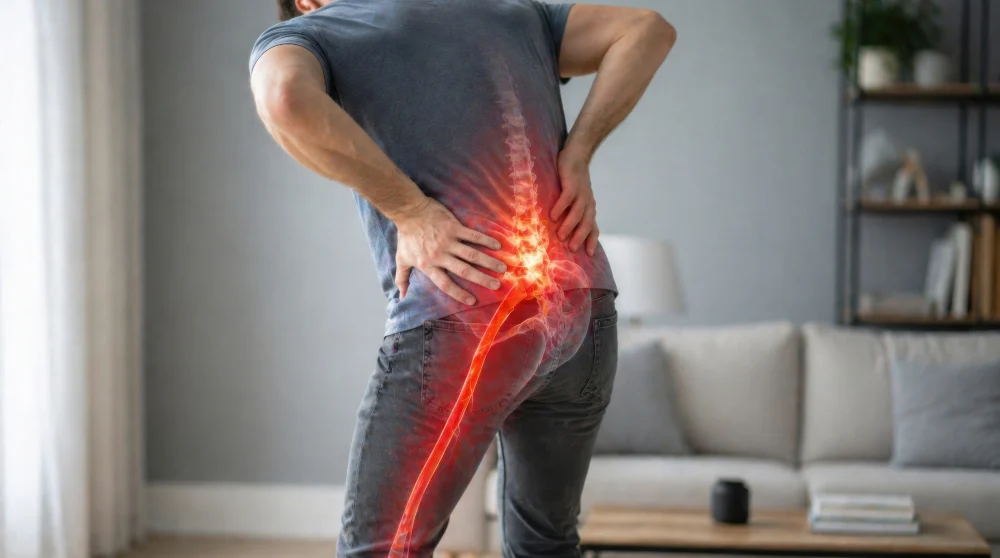
Sciatica is commonly used to describe pain that travels from the lower back or buttock into the leg. It may also involve tingling, numbness or weakness. That pattern can be associated with irritation of the sciatic nerve or the spinal nerve roots that form it – but “sciatica” is a symptom description, not a complete diagnosis.
At Revive Spine and Wellness in Jupiter, the decision to use Cox Flexion Distraction begins with identifying the likely source, checking neurological function and screening for signs that require medical assessment. For a person whose examination findings support this approach, the Cox 8 table provides a controlled, table-assisted option that can be adapted to the findings and comfort of the individual.
Why the Cause Matters
Possible contributors to sciatica-like symptoms include a herniated or bulging disc, degenerative changes, spinal stenosis, spondylolisthesis and other causes of nerve-root irritation. Pain arising from the hip, sacroiliac region, muscles or peripheral nerves can sometimes feel similar. Less commonly, serious medical conditions can produce leg symptoms. Treating every case as “a pinched nerve” risks missing the reason the symptoms are present.
The distribution also matters. True nerve-related symptoms may follow a recognizable pathway and can be accompanied by changes in strength, sensation or reflexes. Leg pain without low-back pain can still be nerve-related, but an examination is needed to separate plausible causes.
What the Evaluation Includes
Dr. Robert Kleinfeld reviews the onset, location and behavior of symptoms; prior injuries or surgery; general health; medications; and activities affected. The examination may assess lumbar and hip movement, strength, sensation, reflexes and symptom response to selected positions. Existing imaging is reviewed when relevant. An MRI may help in some cases, but it is not automatically required merely because pain travels into a leg.
The purpose is to decide whether the presentation is consistent with a mechanical problem that may be managed conservatively, whether the plan needs modification, or whether referral or further investigation should come first.
How the Cox Table-Assisted Approach Works
Cox Flexion Distraction is a doctor-controlled chiropractic technique performed on a specialized table. For lumbar care, the table permits measured movement while the chiropractor maintains directed contact at a selected spinal area. This differs from relying only on a rapid manual thrust. The position, range and direction are chosen according to the examination and adjusted according to your response.
At Revive, Cox Flexion Distraction is the table-assisted technique used to provide spinal decompression. The two terms describe the same core approach from different perspectives: Cox identifies the named technique, while spinal decompression describes the service you may be considering.
What Is the Treatment Trying to Accomplish?
When the approach is appropriate for you, the plan may aim to make movement more comfortable, reduce aggravating mechanical load and improve function while irritated tissues settle. Cox educational materials discuss biomechanical effects involving disc and nerve-root spaces. These ideas do not prove that every case of sciatica will respond, and the technique should not be advertised as permanently removing pressure, curing a disc problem or preventing surgery.
Treatment may be combined with another chiropractic technique, soft-tissue care, supportive modalities, home exercises or activity guidance when appropriate. Just as importantly, the plan should include measures that show whether it is working.
What to Expect During Care
During a session, you are positioned on the Cox 8 table while Dr. Kleinfeld applies controlled contact and movement. Revive’s decompression sessions are generally about 20 minutes, although the full appointment can vary. You should speak up if symptoms travel farther down the leg, intensify, or feel unfamiliar. A clinician may change the direction, range or overall plan based on that response.
The number of visits cannot be determined from the word “sciatica.” Duration, neurological findings, functional limitations and progress all influence care. A sound plan uses scheduled re-evaluation and clear goals, such as improving sleep, walking, sitting tolerance, strength or the distance that pain travels.
Activity During Recovery
Complete inactivity is not automatically the answer. Many people benefit from staying within tolerable activity limits, changing positions regularly and following individualized exercise or movement advice. Golf, pickleball, Pilates, lifting and prolonged sitting place different demands on the lower back and hips, so guidance should match the activity and the person rather than rely on one generic rule.
When Sciatica Symptoms Need Prompt Medical Attention
Seek urgent medical assessment if you develop:
- New bowel or bladder difficulty
- Numbness in the saddle or groin region
- Rapidly worsening weakness
- Severe symptoms after major trauma
- Fever with severe back pain or other sudden systemic symptoms
These are not routine decompression appointments. Call emergency services when the situation is severe or immediately threatening.
The Bottom Line
Cox Flexion Distraction may be considered for some people with sciatica-like symptoms, especially when examination findings support a lumbar mechanical or nerve-root component and no contraindication is identified. The table is a tool – not a diagnosis and not a guarantee. Care should be guided by examination, monitored response and timely referral when needed.
To discuss leg pain, tingling or numbness with a Jupiter chiropractor, contact Revive Spine and Wellness and schedule an evaluation.
How Neurological Findings Influence the Plan
Strength, reflexes and sensation help show whether a nerve root may be affected and whether the presentation is stable. Mild sensory change is evaluated differently from rapidly worsening weakness or changes involving bowel, bladder or saddle-area sensation. The latter require urgent medical assessment rather than routine table-assisted care.
What Improvement May Look Like
Progress may include pain no longer travelling as far down the leg, improved walking or sitting tolerance, better sleep, increased strength or a gradual return to activity. A lower pain score after one session is not the only measure. The pattern over time and the neurological findings matter.
When the Pain May Be Coming From Somewhere Else
Hip disorders, sacroiliac-region pain, muscular referral, peripheral nerve irritation and vascular or other medical conditions can resemble sciatica. Examination of the lower back alone may not be enough. The history and physical assessment should consider the hip, leg, circulation and relevant medical factors before a lumbar treatment is selected.
Frequently Asked Questions
Is all pain that travels into the leg sciatica?
No. Hip, muscle, joint and peripheral nerve problems can resemble sciatica, and medical conditions can also cause leg pain. The history, neurological findings and symptom pattern help identify the likely source and whether referral is needed.
Does Cox Flexion Distraction cure sciatica?
It should not be described as a cure. Sciatica has different causes and severities. Cox Flexion Distraction may be one conservative option for a person whose examination findings support this approach, with progress judged by symptoms, neurological findings and daily function.
Will I need an MRI?
Not necessarily. Imaging is considered when the examination, red flags, symptom progression, prior surgery or lack of expected improvement makes it useful. A scan should answer a clinical question rather than be ordered automatically for every episode of leg pain.
How many sessions are usually needed?
There is no universal number. Dr. Kleinfeld discusses an initial plan and re-evaluation based on the findings, then adapts care to the response. A plan should change when symptoms worsen, neurological findings progress or agreed functional goals are not improving.
Can Cox care be combined with an adjustment or exercises?
Yes, when clinically appropriate. Dr. Kleinfeld may use Cox care alone or with Diversified Technique, soft-tissue care, supportive modalities or home exercises. The combination depends on the examination and patient tolerance.
When should I seek urgent medical care?
Seek urgent assessment for new bowel or bladder changes, saddle-area numbness, rapidly increasing weakness, serious trauma, fever with severe back pain or sudden concerning symptoms. Severe or immediately threatening symptoms require emergency services.
Editorial Sources
MedlinePlus, “Sciatica”: https://medlineplus.gov/sciatica.html
MedlinePlus, “Herniated Disk – Slipped Disc”: https://medlineplus.gov/herniateddisk.html
Cox Technic, official technique overview: https://coxtechnic.com/the-technic